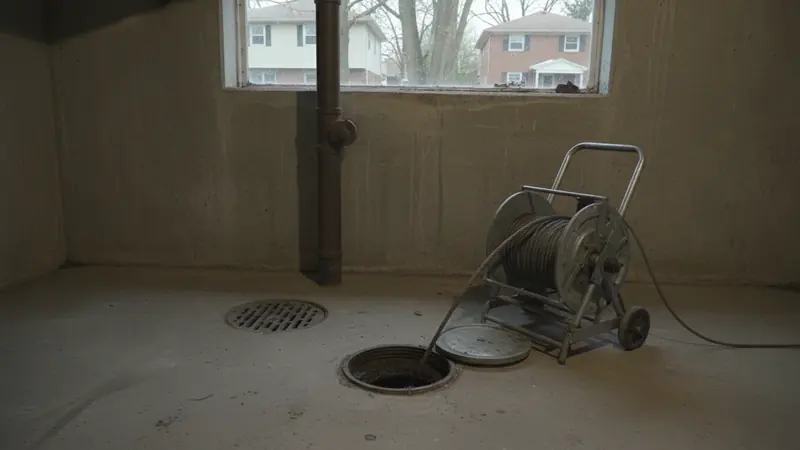
What to expect from main-line cleaning. How Howard County's cleanout affects the work. What to ask when the line blocks again.
Define the stretch of pipe before work starts
Ask where the crew will start your “main-line cleaning”. Ask where it expects to finish. The job means clearing the shared wastewater pipe from your house towards the public sewer. Make sure the work order distinguishes your pipe from the public main. “We cleaned the sewer” leaves too much unanswered.
The county recommends checking the public side first, as the Howard County drain-cleaning overview explains. Its crew can send a high-pressure hose from the cleanout near the property line towards the main. That check does not tell you whether the pipe back towards your house is clear.
Tell the private crew which fixtures backed up. Explain what was running at the time. Tell them what the county checked. Ask them to name the access point on the invoice. Ask them to record which way they worked along the pipe. If they cannot reach the planned endpoint, ask them to record where they stopped. Ask them to say why. You can compare those notes if sewage backs up again.
Source: Howard County Bureau of Utilities, Sewage Backups, undated webpage; no effective date stated. Work-order questions are editorial guidance. Gathered 2026-09-23.
Find usable access without guessing the route
Howard County can help find a buried property-line cleanout using the location information it has and a metal detector. But the county says it has no maps showing exactly where the plumber laid your private sewer. It does not mark that route. Finding the cap does not tell you where every bend or buried defect lies.
Before you pay for digging, ask what the crew needs to do. Uncover an existing opening? Add access? Expose damaged pipe? Those are different jobs. Ask who will locate the private pipe. Ask how the crew will mark where it plans to dig.
The county's adopted plumbing code requires more than “there is a cap somewhere.” Required cleanouts must be accessible. Below-ground cleanouts must extend to ground level. They generally have to let equipment travel with the drainage flow. There are exceptions for specified fittings. Ask whether the proposed opening serves the stretch you need cleaned. These rules apply to work covered by the code. They do not prove that every older house already has suitable access.
Source: Howard County Bureau of Utilities, Locating and Marking Public Water & Sewer Lines, undated; Howard County DILP, Adopted Codes, and International Code Council, Howard County adopted plumbing code, Cleanouts, effective 2025-09-07. Gathered 2026-09-23.
Match the cleaning method to what is blocking flow
Mechanical tools break up or cut material in the pipe. Water jetting uses fast-moving water against the pipe walls to loosen deposits. The water also moves them along. EPA's sewer-cleaning guidance describes both methods, including their use against grease and roots. It warns that inexperienced operators using high-velocity equipment can cause backups into homes. The choice of equipment matters. So does how the operator uses it.
Ask what the crew thinks is blocking the line. Ask why its proposed tool suits that problem. Ask how it will get into the pipe. Ask how the pipe's known condition affects the choice. Ask what happens to the loosened material. If the crew changes methods, ask what it learned that makes the change worthwhile.
A camera does a different job: it helps the crew see inside the pipe. Ask whether the quote includes footage after cleaning. Ask whether you get a copy. Ask whether water or remaining debris hides any stretch. “The camera went through” does not mean “we could see the pipe clearly”.
EPA's document deals with running sewer systems. It explains these differences between methods. It does not set a price, pressure setting or household cleaning schedule for Howard County.
Source: U.S. Environmental Protection Agency, Collection Systems O&M Fact Sheet: Sewer Cleaning and Inspection, published September 1999; technical guidance, no regulatory effective date stated. Gathered 2026-09-23.
Set the price and stopping point before equipment enters
We could not find a Howard County residential price for main sewer line cleaning from a primary source. The county overview covers published government charges. Those do not tell you what a private crew should bill for this job.
Ask each bidder to quote for the same stretch of pipe so you can compare prices. Get answers to these questions in writing:
- Does the price cover opening the access point? Does it cover closing it afterwards?
- Does it include the proposed cleaning method? Can switching equipment add a charge?
- Is camera footage included? Will you receive the recording?
- What do you owe if the crew cannot clear the line or reach the endpoint?
- At what point must the crew get your approval to continue?
Ask what a return visit covers. If the crew promises to “come back if needed”, ask whether it will charge again. Ask what conditions that promise excludes. Ask whether it will just clear another blockage or investigate why it returned.
If the crew proposes replacing pipe, the county's permit-and-inspection process applies. The overview explains that process. Before you agree to turn a cleaning visit into a repair job, get the proposed work in writing. Get a separate price for it too.
Source: Howard County DILP, Licenses & Permits Division — Sewer/Water Repairs or Replacements, undated webpage; no effective date stated. No local primary-source retail cleaning price located; quote questions are editorial guidance. Gathered 2026-09-23.
When the line blocks again, ask what remained
EPA lists roots entering through pipe openings as a possible cause of sewer overflows. Broken pipes can cause them too. So can accumulated material. These are possible causes to investigate. They are not a ranking of Howard County household failures. Evidence that material has been cleared does not explain how it entered the line.
If roots appear in the footage, ask the contractor to show where they enter. Ask what condition the pipe is in around that spot. If the contractor recommends replacing the entire private line, ask why the evidence supports that much work. A recording that stops at an obstruction cannot tell you about the unseen stretch.
Bring the previous invoice and video to the next visit. Ask whether the crew found the blockage in the same place. Ask whether it reached farther this time. Ask whether it could see the pipe after clearing it. Keep those answers with the new recording. They help you compare regular cleaning with repairing a specific defect.
We could not find a Howard County primary source saying how often to clean residential main sewer lines. Ask how any proposed schedule fits your line’s observed condition and history. Ask what would prompt another camera check or a discussion about repairs.
Source: U.S. Environmental Protection Agency, Sanitary Sewer Overflow Frequent Questions, undated guidance; no regulatory effective date stated. No Howard County residential main-line cleaning interval located; evidence-review questions are editorial guidance. Gathered 2026-09-23.