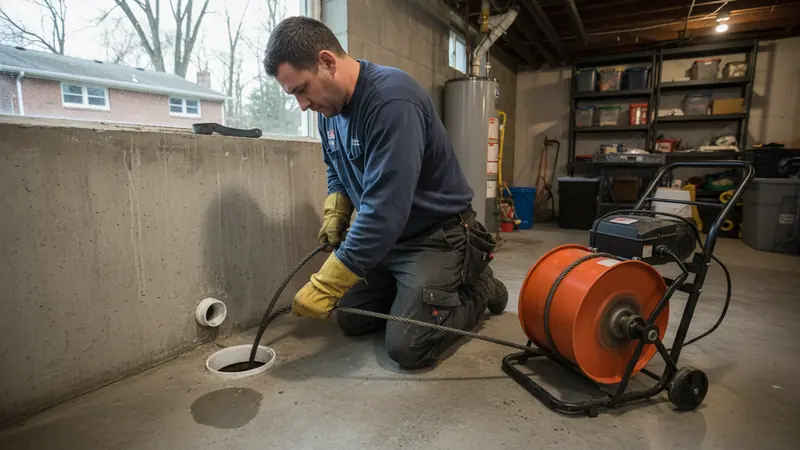
Who to call for a sewer backup, what a repair permit costs, and what the county's own records can tell you about a drain that keeps blocking.
Every figure here carries the date we gathered it. Where the county publishes a fee we say so; where a price is a contractor's, we say that too. Where we could not settle a question, we say that rather than guess.
Before paying for a sewer call
If your house is on public sewer and a drain backs up, call the Bureau of Utilities before you call a plumber. Howard County asks you to: 410-313-4900, or 410-313-2929 after hours. A crew can flush from the cleanout near your property line out toward the main. That may clear the blockage outright. If it does not, you now know the county's side is open. That is worth knowing before anyone starts charging you by the hour.
Look after the cleanout itself. The county says two things go wrong most often. Mowers hit it. Landscapers bury it. Keeping it in good order is yours to do. The county will fix these parts:
| County cleanout service | Published charge |
|---|---|
| Replace brass plug | $20 |
| Replace entire cap assembly | $45 |
Those are charges for the parts, not for cleaning the drains inside your house. The county does not publish a call-out charge for a sewer truck, so we are not going to invent one.
Before a private contractor starts, write down what Utilities checked and where. Keep it with whatever invoice you end up paying.
Source: Howard County Bureau of Utilities, Customer Service — Sewage Backups, Water & Sewer Office Location, and Sewer Cleanout Cap Repair, undated webpage; no effective date stated for cap-repair charges. Gathered 2026-09-22.
Do you actually need a permit?
Repairing or replacing a sewer clearly does need a permit. DILP says to pull the plumbing permit through Citizen Access before you book the repair inspection. Someone may arrive to clear a blockage and end up digging. That is no longer the job you agreed to. Price it and permit it as the different job it is.
For cleaning on its own, we could not find county wording clear enough to give you a straight yes or no. Note that the state not requiring a licence is not the same as the county not requiring a permit.
We could not settle this one. Clearing a blockage and replacing pipe are two different jobs, and we found no permit fee for cleaning by itself. DILP will tell you which side your job falls on: 410-313-2455, option 4. Do not ask them about “drain cleaning” — that phrase is what makes the answer vague. Ask whether the method being proposed will install or change any pipe or fixture. Then ask the same about a connection or a lining, because relining is exactly the job that blurs the line.
If you are doing the work yourself, there is a wrinkle. County Code 3.301(d) lets you off the permit for some work you do with your own hands. You have to tell the county in writing, build it to code, and let an inspector in. You may not make the final connection to a public or private disposal system — that part is carved out.
The law and the form do not agree. The code calls it an exemption. The county's own homeowner form calls it a permit and charges for it: $50 plus a $5 technology fee, so $55. The form is narrower too — it rules out exterior work, gas work, and the connections between your house and the disposal or water systems. We have followed the form here. It is the thing you will actually be handed. And we are not going to tell you a free homeowner sewer permit exists. Ring DILP and get the discrepancy sorted out before you rely on it.
The form only works if you live in the house and do the work yourself. Get it inspected before you cover anything up, and no later than two days after you finish. It does not let you hire an unlicensed worker to replace your drains.
Source: Howard County DILP, Licenses & Permits Division — Sewer/Water Repairs or Replacements, undated; Howard County Council, CB26-2025, section 3.301(d), effective 2025-09-07; DILP, Homeowner Request for Plumbing Work, revised 2026-03-09. Gathered 2026-09-22.
What the permit costs
The FY27 schedule, adopted through Council Resolution 83-2026, took effect July 1, 2026. Relevant entries are:
| Item | County fee |
|---|---|
| Filing fee, except express plumbing permit | $50, non-refundable |
| Storm, gas, water or sanitary piping: first 200 feet | $100 |
| Each additional 100 feet or fraction | $25 |
| Sewer connection at right-of-way or building | $50 |
| Cap off sanitary system | $50 each |
| Residential plumbing minimum, including first fixture | $25 |
| Additional residential fixture | $5 |
| Replacement sewer ejector, sump pump or laundry tray pump | $25 each |
| Express plumbing permit, up to 5 fixtures | $50 |
| Technology fee | 10% |
| Work started without required permit | $100 additional |
The piping line does not cover sanitary or water pipe 8 inches or larger. And none of this is a flat rate for cleaning a drain.
We are not going to add these up for you. The schedule does not say which connection charges apply to which repair, and it does not say what the technology fee is a percentage of. So we have left the rows as we found them. Ring DILP on 410-313-2455, option 4 and ask what your actual job comes to. In particular, do not assume the express permit that covers five fixtures will cover replacing a sewer.
Source: Howard County DILP, FY27 Plumbing Permit Fee Schedule, Council Resolution 83-2026, effective 2026-07-01. Gathered 2026-09-22.
The inspections — and what the timing actually means
The county's scheduling brochure distinguishes new sanitary sewer installation from repair:
| Inspection | Code |
|---|---|
| Sanitary sewer repair or replacement | 731 |
| Combined sewer and water repair or replacement | 730 |
| New sanitary sewer installation | 722 |
| Plumbing groundwork | 712 |
| Plumbing rough-in | 720 |
| Final plumbing | 705 |
Pick the ones that match your work. You are not expected to book all of them for every repair — your permit and your inspector decide the order.
Book on 410-313-3800. Once the permit is issued you can ask for the next day, or anything up to seven working days out. To book by text, send “Schedule” to 888-297-9841. If you want a two-hour arrival window rather than a whole day, ring 410-313-1823 between 7:30 and 8:30 a.m. on the day itself.
Emergencies have their own route. The Inspections & Enforcement Division wants emergency water and sewer requests on 410-313-1840 before 9 a.m. on the day. Licenses & Permits say to take the next automated slot first. If you need it sooner, ring the plumbing inspector before that deadline. They will try. They do not promise.
How fast you can book an inspection tells you nothing about how fast a permit is issued. We could not find a figure for how long Howard County takes from application to permit in hand. So we are not claiming one. Nobody should be promising you a same-day permit either. A contractor's schedule should carry four dates, not one. Permit issued. Work done. Inspected. Garden put back.
Source: Howard County DILP, Automated Inspection Request and Permit Information System, linked file dated 2025-04-14, with an internal instruction footer dated 2024-12-27; Inspections & Enforcement Division and Licenses & Permits Division, undated webpages. Gathered 2026-09-22.
What the inspector is actually going to check
Howard County publishes a residential plumbing groundwork checklist. For sanitary drains it covers:
- Correct pipe sizing and approved pipe materials.
- Approved joints and traps.
- Adequate grade, bedding and support before backfill.
- Backwater protection where required.
- Sewage ejectors where required.
Which is why the inspection matters so much. Once the trench is filled in, nobody can check how that pipe was bedded and supported. Before work starts, settle who books the inspection and when the trench may be closed.
The checklist keeps storm and condensate water separate from sewage, and wants that water dealt with properly. So if a contractor tells you every wet basement is a blocked sewer, they have not diagnosed anything yet.
The checklist says what is required, not what usually goes wrong. It does not tell you that bad slope or a missing backwater valve are the common faults in Howard County houses — nobody has shown us that. It does not mean your house needs a backwater valve either. Ask what it is about your installation that triggers the requirement, and make sure the permit covers that.
Source: Howard County DILP, Inspection Requirements — Residential Plumbing, Ground Work, undated webpage. Gathered 2026-09-22.
Who is allowed to do the work
Maryland's Plumbing Board addressed drain cleaning directly in its October 19, 2023 meeting. After consulting counsel, it advised that drain cleaning did not require a license. The minutes also record that pipe replacement requires a plumbing license.
They drew a neat line around toilets. Someone without a licence may lift your toilet to get at the drain, but may not fit you a new one. The toilet that came off has to go back on, and a new wax ring was as far as the Board would go.
That answer only covers what the Board was asked. The same minutes refused to say what other licences sewer cleaning might need. Sewer cleaning is not plumbing, as the statute defines it. So read it as the Board talking about its own licence and nothing more. Their number is 410-230-6379.
If someone proposes repairing pipe, get the name and licence number of the plumber responsible. Maryland lets you look it up by name, location or licence number. The name on the van does not tell you who is qualified to replace anything.
Ask at the moment the job changes shape. Clearing a blockage is one decision and rebuilding part of your drains is another, even when the same company offers you both in the same visit.
Source: Maryland Department of Labor, Board of Plumbing, Business Meeting Minutes, 2023-10-19, Correspondence, approved 2023-11-16; Board of Plumbing, undated contact page; Plumbers Public Query, updated 2026-05-28. Gathered 2026-09-22.
Which code your job is held to
Howard County adopted the 2024 International Plumbing Code with local amendments, effective September 7, 2025, through CB26-2025.
Those local amendments matter as soon as a cleaning call turns into alteration work. The county swapped the model code's administrative chapter for its own, and it deleted the section on air-admittance valves outright. So if someone proposes changing your venting, ask which local rule they are working to. A diagram out of the model code does not answer that.
The county's Adopted Codes page keeps current editions separate from old ones, and current is where a new proposal starts. An old inspection sticker is useful evidence of what is already in the ground. It says nothing about the rules for the work you are about to buy.
Source: Howard County DILP, Adopted Codes; Howard County Council, CB26-2025, local amendments to administration and section 918, effective 2025-09-07. Gathered 2026-09-22.
What Howard County houses are — and what actually goes wrong
The 2024 ACS one-year estimates report 27,137 Howard County housing units built during 1980–1989, or 21.4% of the county's housing stock. The published margins of error are ±2,154 units and ±1.7 percentage points.
So there are a lot of houses of a certain age here. That is all it tells you. It says nothing about what any one house's sewer is made of, what condition it is in, or whether it has already been replaced. Nobody has inventoried the private drains in this county and no local failure rate exists that we could verify. If someone tells you a particular Columbia village is mostly failing cast iron, clay or Orangeburg, ask how they know — a build date is not evidence.
The county is on firmer ground about grease. Its Pretreatment Program explains that fats, oils and grease build up inside pipes, choke the flow and back things up. What they ask is simple. Wipe the grease out of the pan before it goes in the sink. Keep cooking fat out of the disposal.
If grease is what blocked your drain, ask two questions afterwards. Where was it found, and how was that stretch of line cleared? Water running again solves today's problem and tells you nothing about the state of the pipe. Keep whatever they wrote down, so that if it happens again you can compare the two visits.
Howard County also provides a disposal alternative: Alpha Ridge Landfill accepts liquid vegetable-based cooking oil from residents. Its guidance excludes mixtures with water, petroleum products or soap, and calls for cooled oil in a tightly closed container. Solidified grease is not suitable for that liquid collection system.
That is local, documented advice on preventing the problem. It does not tell you what share of drain calls in this county are grease, and we are not going to put a number on it.
Source: U.S. Census Bureau, 2024 ACS one-year Selected Housing Characteristics for Howard County, reproduced by Maryland Department of Planning; Howard County Bureau of Utilities, Pretreatment Program, undated; Howard County Environmental Services, Cooking Oil Recycling, no effective date stated. Gathered 2026-09-22.
When the house has septic instead
If your house is on septic, a slow drain is a different problem and wants a different look. The Health Department's fact sheet lists what tends to be wrong: a waterlogged drainfield, too much water going in, grease or solids, or roots. The signs are slow drains and toilets, a sewage smell near the system, and sewage showing up on the ground.
They ask you to have the tank inspected and pumped at least every three years. That is their number for the tank. It is not how often anyone should be cleaning the drains inside your house. They also tell you to skip the septic additives and keep wipes and grease out.
Their repair form is worth reading even if you never fill it in, because it shows what evidence actually counts. It asks when the tank was last pumped, whether anyone has looked inside the tank and at the drainfield, whether the sewage line has been inspected, whether the blockage runs toward the field, and whether anything is surfacing. Those are five different observations, and “the drain is slow” answers none of them.
Send a repair request and a sanitarian will get in touch within three business days, depending on urgency, to sort out review or scheduling. That is when somebody rings you. It is not when you get a permit or a repaired system. Tell them about any addition or other change you are planning to the property while you are at it.
The Well & Septic Program handles installation and repair, and can get you into the property file. Ring them on 410-313-1771. Get those records and your contractor's findings in front of you together, before you decide between working on the line and repairing the septic system itself.
Source: Howard County Health Department, Onsite Sewage Disposal Systems Fact Sheet, currently linked filename dated 2026-03-25 but internal footer dated 2017-02-15; Septic System Repair/Upgrade Information Form, dated February 2020; Well & Septic Program, undated webpage. Gathered 2026-09-22.
What the work is worth
We could not find a Howard County price list for snaking, jetting, a camera survey or replacing a private sewer — not from a primary source. So there is no local average here. And the permit fees above are the county's charges, not the plumber's.
To compare two written quotes, ask for them broken out the same way. What does it cost to find the problem, and to clear it? What does a camera record cost, and the repair itself? Who handles the permit, the inspections, and putting the garden back? Then ask two more questions: what do I owe you if you cannot clear it, and what evidence will you show me before recommending a bigger repair? One number with no scope behind it cannot be compared with anything.
Source: Howard County DILP, FY27 Plumbing Permit Fee Schedule, effective 2026-07-01, establishes government charges only; no county-specific primary-source retail price series located. Proposal-comparison questions are editorial guidance. Gathered 2026-09-22.